Definition: Iron-sulfur (Fe-S) clusters are prosthetic groups found in respiratory chain complexes and numerous mitochondrial and cytosolic enzymes. Iron-sulfur (Fe-S) clusters are essential for numerous biological processes, including mitochondrial respiratory chain activity and various other enzymatic and regulatory functions.
Biogenesis
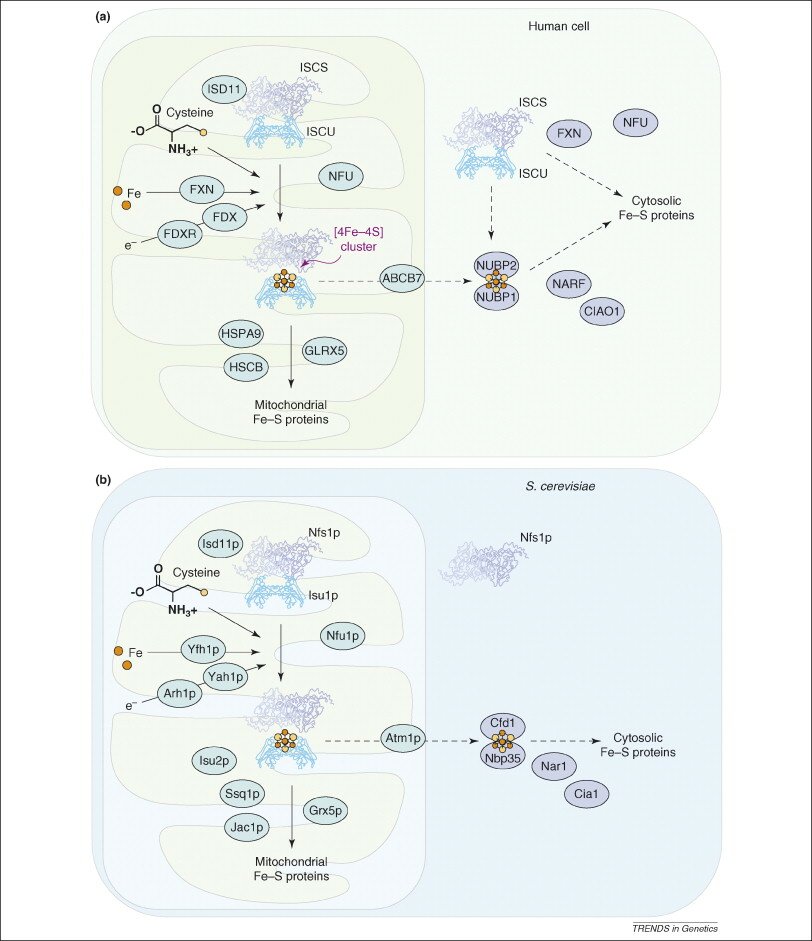
Assembly of Fe-S clusters requires scaffold proteins, such as ISCU, as well as cysteine desulfurases, iron donors, and chaperones.
Human Fe-S cluster assembly proteins are frequently encoded by single genes, and inherited defects in some of these genes cause disease.
Recently, the spectrum of diseases attributable to abnormal Fe-S cluster biogenesis has extended beyond Friedreich ataxia to include a sideroblastic anemia with deficiency of glutaredoxin 5 and a myopathy associated with a deficiency of a Fe-S cluster assembly scaffold protein, ISCU.
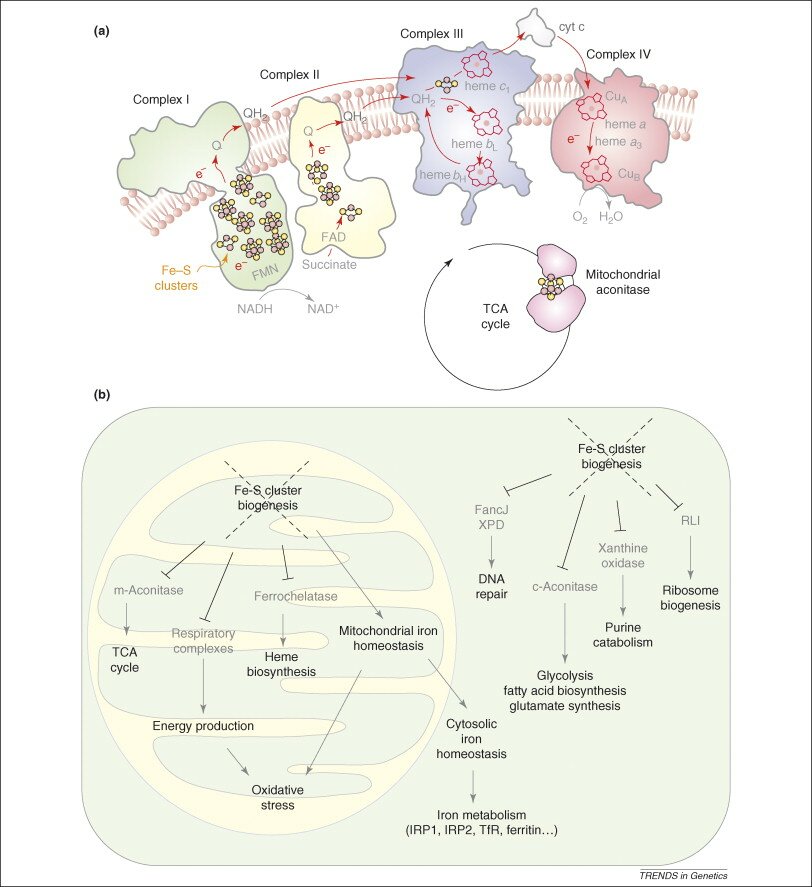
Along the respiratory chain, electrons from the oxidation of NADH (complex I) and succinate (complex II) are transferred through a chain of redox centers consist of flavins, Fe–S clusters, ubiquinone (coenzyme Q(10) and coenzyme QH2), hemes and copper centers (CuA and CuB) to reduce O2 to H2O. The free energy of electron transport is coupled to ATP synthesis.
Fe–S clusters are essential cofactors in energy metabolism. Fe–S proteins are among the most important electron carriers in nature and are particularly important in the mitochondrial respiratory chain, in which up to 12 different Fe–S clusters shuttle electrons through complexes I–III.
The ability of Fe–S clusters to coordinate ligands and stabilize protein structures also allows them to facilitate various enzymatic functions. For instance, mitochondrial aconitase is an integral part of the citric acid cycle (or tricarboxylic acid cycle (TCA cycle) or Krebs cycle), and its [4 Fe–4S] cluster is essential for substrate binding and activation.
Iron–sulfur (Fe–S) clusters are ancient biological prosthetic groups that are essential for many fundamental processes including photosynthesis and respiration.
The most common Fe–S clusters in eukaryotes are the [2Fe–2S] and [4Fe–4S] clusters, which are formed by tetrahedrally coordinated iron atoms with bridging sulfides and are most often ligated to the protein through cysteine residues.
The chemical reactivities of iron and sulfur, together with variations in the composition, redox potential, oxidation state, physical accessibility of the cluster and effects of the local protein environment, enable these versatile cofactors to accept or donate single electrons, catalyze enzymatic reactions or function as regulatory proteins.
For instance, Fe–S clusters are essential components of respiratory electron transfer complexes as well as the tricarboxylic acid cycle (TCA cycle) enzymes, aconitase and succinate dehydrogenase.
In addition, the Fe–S clusters within DNA repair enzymes Fanconi anemia group J protein (FANCJ) and Xeroderma pigmentosum group D protein (XPD) facilitate DNA damage recognition and repair.
Moreover, Fe–S cluster assembly and disassembly in mammalian iron regulatory protein-1 (IRP1) alters the active site conformation and accessibility and determines whether IRP1 binds its mRNA targets in response to oxidative stress and intracellular iron levels.
Pathology
Mutations within other mammalian Fe-S cluster assembly genes could be causative for human diseases that manifest distinctive combinations of tissue-specific impairments. Thus, defects in the iron-sulfur cluster biogenesis pathway could underlie many human diseases.
Disruption of iron–sulfur (Fe–S) proteins can have a myriad of deleterious cellular consequences. Because Fe–S clusters are essential electron carriers and enzyme cofactors in many proteins, defects in Fe–S clusters biogenesis can disrupt many cellular process.
Because Fe–S proteins play a critical role in a wide range of cellular activities, mutations or pathological conditions that disrupt Fe–S cluster stability or biogenesis/repair are associated with several human diseases.
For instance, germline mutations of the gene encoding succinate dehydrogenase subunit B (SDHB), a Fe–S protein in respiratory complex II, are a major cause of cancer of the kidney, adrenal gland and thyroid gland.
Mutations that destabilize the Fe–S clusters in DNA repair enzymes XPD and FancJ are associated with the phenotypes in patients with trichothiodystrophy and Fanconi anemia respectively.
Severe defects in Fe–S cluster biogenesis/repair can profoundly decrease the activities of respiratory complexes, the TCA cycle and the heme biosynthesis pathway, resulting in decreased energy production and increased oxidative stress.
In addition, disruption of Fe–S cluster biogenesis can lead to mitochondrial iron overload and cytosolic iron depletion.
In the cytosol, defects in Fe–S cluster biogenesis might affect cytosolic aconitase (c-aconitase) activity and therefore citrate metabolism, which can disrupt the balance between glycolysis and fatty acid biosynthesis.
Defects in cytosolic Fe–S cluster biogenesis/repair might also impair ribosome biogenesis, and purine catabolism pathways.
References
 Rouault TA, Tong WH. Iron-sulfur cluster biogenesis and human disease. Trends Genet. 2008 Aug;24(8):398-407. PMID: 18606475
MacKenzie EL, Iwasaki K, Tsuji Y. Intracellular iron transport and storage: from molecular mechanisms to health implications. Antioxid Redox Signal. 2008 Jun;10(6):997-1030. PMID: 18327971