gamma secretase
Image Gallery
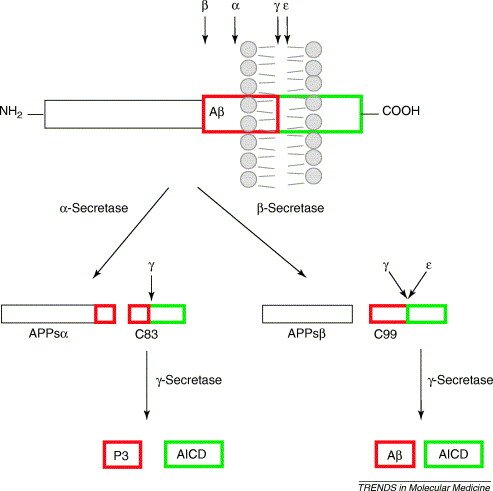
Gamma-secretase is a pivotal enzymatic activity in Alzheimer disease that was hidden within a huge number of unrelated proteases.
The multimeric enzyme complex ?-secretase consists of at least four proteins:
 the presenilins (PSENs)
Aph-1
Pen-2
nicastrin
Knockout (KO) of both PSENs or the mutation of the aspartic residues D257 and D385 in PS results in complete loss of ?-secretase activity and A? production, thus identifying PS as the active centre of the ?-secretase complex.
A protease complex containing presenilins (PSENs), nicastrin, PEN-2 and probably APH-1 provides the long sought gamma-secretase activity.
Presenilin itself appears to be a novel polytopic aspartyl protease of the GxGD type, whereas the other components might be required for substrate recognition, complex assembly, stability and targeting of the complex to its sites of action.
APP processing pathway
APP is a type-1 integral transmembrane protein in which the C-terminal portion of A? is embedded within the cell membrane. APP processing results in or precludes formation of the amyloidogenic A? peptide.
Cleavage by the membrane-associated metalloprotease ?-secretase, the activity of which is probably manifested by several distinct enzymes, occurs within the A? domain (between residues 16 and 17), thereby preventing the formation of A?, and instead results in the release of the large soluble extracellular N-terminal portion of APP (APPs?) and a C-terminal fragment consisting of 83 residues (C83).
C83 might undergo further processing by ?-secretase to release the p3 peptide, which is considered non-amyloidogenic, although it is deposited in diffuse plaques.
To form A?, APP must undergo two sequential endoproteolytic steps, elaborated by distinct enzymatic activities known as ?- and ?-secretase. ?-Secretase, which is the enzyme known as BACE1 (?-site APP-cleaving enzyme), cleaves APP at the N-terminal region of the A? sequence.
Cleavage by ?-secretase generates a slightly shorter soluble N-terminus (APPs?) and the amyloidogenic C-terminal fragment (C99). The cleavage of C99 by ?-secretase liberates the C-terminal 50 residues of APP, which is known as APP intracellular domain (AICD) and A?.
References
Haass C, Steiner H. Alzheimer disease gamma-secretase : a complex story of GxGD-type presenilin proteases. Trends Cell Biol. 2002 Dec ;12(12):556-62. PMID : 12495843